editorial

abstracts

f2f 2 url & b ond: space/time and the dissemination of community
Darren Tofts

‘[Captain Cook):(Re-Births):(Byron Bay]’
Terrence Maybury

The edges of the earth: critical regionalism as an aesthetics of the singular
Warwick Mules

Regionality and New Media Art
Grayson Cooke and Dea Morgain

Ghostwriting: The Alkimos and its Ghosts
Phillip Roe

ISSN 1444-377

ISSN 1444-377

Issue No. 12 (December 2005) — Rethinking Regionality

The edges of the earth: critical regionalism as an aesthetics of the singular
By Warwick Mules

Regional Life

Regions have for too long been subject to a discourse that places them at the hinterland of powerful metro-centres. According to this view, a region owes its existence to power emanating from the centre—a one way flow, as if all knowledge, all power exists originally at the centre radiating out to the periphery. The advent of globalisation favouring local/global interconnections has the potential to disrupt and redefine the relation between the centre and its regions, where local sites previously subordinated to the power of the metro-centres can now find empowerment in their global interconnections. [1]

Despite this potential for local empowerment, there is nevertheless a growing awareness that centres are more powerful than ever, while regions languish behind them. Instead of looking after their regional hinterlands, centres have abandoned them in search of their own global destinies. [2] What happens to hinterland regions when threatened with abandonment by their historically defined centres? They must themselves become globally interconnected, independent of their metro-centres yet fully linked to the global field.

In this paper I explore the possibility of redefining regions in terms of critical regionalism, which Wilson and Dirlik define as “an aesthetic of rearguard resistance rearticulat[ing] borders as spaces, genres, and enclaves of cultural preservation and community identity to be set against global technologies of modernization or image-cultures of the postmodern” (4-5). What I am seeking to define is a critical regionalism concerned not so much with a politics of resistive identity formation, as Wilson and Dissanayake's definition suggests, but with a way of re-arranging the experience of life itself as an historically received event—as a localised practice of remaking images. [3]

This localised practice, I argue, needs to be reflexive in its operations, resistive to centre/margin power relations, and life affirming. From the perspective of the centre, regions lack life; they can only duplicate the life that originates at the centre. Life lived in the regions must be copied from the centre or not lived at all. As a consequence, living in regions under the regime of centre authority is to live in resistance. [4] It is time for this power of resistance to seek new ways of affirming itself, to live life not in, but out of resistance. To live life out of resistance is to live life other than what it must be. [5] Living life out of resistance means making a future; it means refusing the life-present as a copy of the centre's will to power, and instead reshaping the life-present into something presently unknown, an experiment in making. To do this, one must struggle with the material presently at hand, to make something of it other than what it has already been prepared to do.

The Edge of the Earth

Everything begins and ends as material. [6] Even information, one of the most abstract elements in the modern capitalist enterprise, is always “earth bound” (bound by the earth/bound for the earth). In the information age where all things are subject to the incessant flows of data, a stubborn residue remains, singular points of contact, thing to thing, matter to matter as an almost invisible yet palpably present material stratum—the earth—in and through which things subside and emerge in an incessant becoming and fading away. If data is today something projected into the skies, it is nevertheless destined for the earth as its material source, its re-entry as the “origin” of earthly affects. [7]

By earth I do not mean the primary source of all things, but the rematerialised effect of a massive process of technological dematerialisation underway since industrialisation. [8] Exposed to the light of a new kind of tele-presence, the earth shimmers in its own derealization through the lightning speed of information passing through it. To be “earthed” in today's telecommunication culture is to be bound to the unboundedness of materiality in its interconnection with the skies; to live life at the interface between the earth and the skies as an experience of Nachträglichkeit, or the delayed/deferred effect of technologically mediated presence as life lived elsewhere by being also here at this place at this time. To be earthed is to be subject to trauma, or the effects of the delayed return of a primary contact (Foster 30-32). As “original” material (as home, as ground) the earth retains itself, but only through a traumatic exposure to its own dematerialisation, through the “electromagnetic conditioning of . . . territory” (Virilio 12).

As products of technological dematerialisation in the global age, regions are a mixture of data and earth, historically made through the accumulation and condensation of material and informational configurations that ground inhabitants in a space-time reality which is as remote from their daily life as it is close at hand. As “original” ground, regions constitute the substrate of life. But as dematerialised territory, their borders do not bind into a coherent whole. They intercalate point to point in a shifting constellation of edges.

Jean-Luc Nancy has written about edges. An edge is the exposure of a limit to contact: “the edge is that through which the limit makes contact or where it makes itself contact” (“Banks, Edges” 47). To be “in” a region is to be at its limits, at the very edge of something—on the periphery as they say. To seize this mode of being is to be rendered singular by exceeding the limit at its very limit, to be in contact with a proliferation of edges adjacent to one another, here, there, and everywhere, all at once: “on the limit, singulars are side by side. They touch each other thus, that is to say that they part from nothing of which they partake. The edges are all one for the other in a double rapport of attraction and repulsion” (47). The first step towards a critical regionalism is to seize one's place in a region and render it singular by revealing its specific character as an edge, right at its limit.

Contact aesthetics

If regions are edges, they nevertheless have their centres. But these centres are never at the centre. Rather, they may be anywhere along the edges, as nodes of varying power. Centres are themselves hollowed out by the edges of regions, revealing a labyrinth of edges, a de-centring where any given point may be linked to any other in an incessant interlinking, which is also a perpetual disconnecting. In these milieux, opportunities abound, but at a cost. To take advantage of them, locales must cut themselves adrift from their historical ties to the centre, from the perspective of the centre that looks out to the region as lacking life.

But historicity—the temporal awareness of the past as part of the present—is not abandoned. Rather the past, stripped of its duty to serve the perspective of the centre, becomes available as material for remaking the local otherwise, as part of a new kind of life, a new beginning. The materiality of the past, its residual affect in the present, its ruinous and fragmented being as earthbound, useless or discarded, covered over and repressed, needs to be brought to light in its singularity as the present-past, as the articulation of the past and the present together in an irruptive event (as trauma) into the continuity of space and time. [9]

My aim here is to introduce affective history to the local/global nexus, as an archaeological tracing of surviving remnants that continue to have effects in the present. The present does not exist in and of itself, but finds support in a material substrate, an archival storage that founds and commands the future through hermeneutic authority. An archive is earthed information, dormant yet potentially active, promising a future that needs to be brought to light and reshaped: “The archive has always been a pledge, and like every pledge, a token of the future. To put it more trivially: what is no longer archived in the same way is no longer lived in the same way” (Derrida Archive Fever 18).

An archive allows life to be lived in a certain way. To activate the archive by changing it is to be configured differently, to be taken somewhere else, not to the past as a real historical location, but to a future-past, to a future yet-to-come, whose dimensions must still be made—a making. [10] But this future does not come easily. It must come from a dangerous engagement with the temporality of the present in its juxtaposition to the past. It must disturb the very earth it comes from. [11]

To disturb the earth is to challenge the original—to make the origin expose itself to the light of the skies as dematerialised ground. Through archaeological tracing, the remains of a now fragmented past can be dug out and exposed to global perception which no longer sees them as evidence of an original truth, but as material to re-imagine the future. This kind of critical activity is not concerned with seeking a new identity, or seeking to restore an older identity repressed or covered over by modern forms of life. Rather it is concerned with an aesthetics of felt experience, as a reflection on the body in contact with other bodies, singularities “in touch” with others. [12]

The key word here is “experience” understood in terms of its older meaning of experimentation (Williams 126). To experience something is to experiment with it by responding to a problem that it presents—to put something to the test. Experimentation involves dealing with the singularity of something, its unique, contingent and accidental being, as opposed to its “sameness” as part of generic or formal arrangement. By situating itself right at singularity, experimentation opens things up without knowing in advance where it might lead. [13]

To aestheticise experience is to respond to the problem that the body has in its capacity to unify itself in the affective-perceptual world in which it is immersed. In a globalised field, bodies become subject to deterritorialised flows of data and information, making them spread through time and space. In the contemporary global field of rapid information flows, bodies are no longer anchored in specific times and places, but melt into the milieu of the global field. The problem posed for experience within the global milieu then is not one of unity, but one of contact: how does a body remain in contact with itself, and with others to which it feels an affinity?

An aesthetics of experience would be concerned with the problem of contact, by making bodies affective to one another within emerging globalised fields. However, the problem of contact always poses itself from an already constituted techno-cultural position, in which the technologies of representation have already become normalised. Ways of seeing and feeling are historically produced through imagined communities, and through the modalities of technologically framed identities. Experience already appears to have solved its problems. Bound up as it is in the technologies for seeing, hearing, feeling and communicating, its “life” has already become normalised. Life feels normal.

Normalised experience cannot produce a future other than the one that it already knows. Instead we need to think of experience as experimentation. We need to deframe the technologies of representation by bringing them to earth, by making them materialise into something that can become the contingent ground for a new life. Paul Carter's idea of material thinking may provide a way forward here. Carter argues for a kind of creative practice working to “materialise discourse” (9). Thinking (and here Carter is referring to critical thinking and critical practice) needs to be connected directly to visual and tactile experiences in terms of an “eidetic consciousness” (31) capable of breaking through the ossified meanings embedded in regional discourses, working with material remains (fragments) as a creative practice that “enacts, rather than symbolises, process” (42). Carter's practice of material thinking, which owes much to Walter Benjamin's idea of the dialectical image, leads to a remembering, not as an invocation of the nostalgic past in the name of a self-same present, but as a re-membering, a re-shaping of bodily self-awareness in its traumatic engagement with the otherness that lies dormant as the remainder of a repressed or forgotten history. To remember like this is to think otherwise, to think in an activity that makes life other than in terms of a future already known—to form a new body.

An art practice along these lines, as archaeological bricolage, needs “to inscribe the material basis of visuality in the unthought of the image and to disrupt its affect of immediacy, plenitude and truth” (Beller 69). A good example of the kind of art work I am thinking of here can be found at the Mongrel web site of the Tate Gallery in London. Digital artist Mike Harwood has recomposed some of the master art works in the gallery by grafting onto them images from the local Thames River environment where the gallery is physically situated. Images of mud and other earthy textures, as well as images of Harwood's own body are mixed into various art works by Turner, Gainsborough, Constable and Hogarth, all canonical English artists whose works have defined a specifically visual British identity. Here are Harwood's accompanying remarks to the web site exhibition:

I have tried in this collection to play with the broken links within the Tate's collection, grafting on the skins of people who are close to me, dragging parts of the collection through the mud of the Thames , and infecting some of it with a relevant disease.

Harwood deconstructs the images into a decoupage of juxtaposed image-fragments drawn from the locale in which they are situated, a practice ‘that opens painting up to the volatile complexities of its “pollution', violation, fertilisation, community” (Smith 170).

Harwood's art work takes on a critically regional inflection in the sense I am developing here because it works with residual material as affective history torn from its original linkages, exposing the edge of an emerging visual terrain that could not be seen before. [14] The “broken links” with Tate's past are reconnected, not in order to strengthen the authority of the art works, but to re-link them to their regional materiality; to materialise their imagistic aura into a renewed vision of a future that the art works themselves cannot foresee. This work is not pretty. Rather, as Anna Munster argues, its aim is to aestheticise the body of the viewer, making it come into close contact with surface affects, and to make an environment in which these affects might change perceptions. Munster refers to this kind of art practice as “approximate aesthetics”—a practice “that can create zones through which the organic and the machinic become approximate to each other” and which “connects to life as a process of composing/compositing the self”. Digital art seems best suited to engage in approximate aesthetics because of its power to bring disparate objects together within virtualised perceptual and tactile environments, rendering art works materially close at hand instead of distantly present as auratic presences.

Anthony's Rest

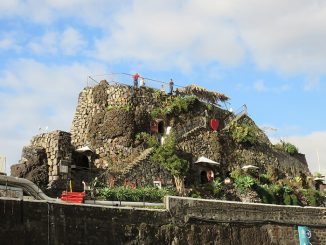
Just down from where I live on a small hill on the outskirts of Bundaberg, a sugar producing coastal town in Queensland, stands Anthony's Rest, a platform jutting out from the hill looking out over the cane fields and to the sea beyond. Built by South Sea Islander labour in 1888 for the visit of the colonial governor of Queensland at the time, Anthony's Rest is constructed of thousands of volcanic boulders piled up into a platform ten metres high. [15]

Taking six months to complete, Anthony's Rest provided a view of the land, which was at the time being cleared for agricultural cultivation. This view was one of surveillance. The viewer's relation to the view took the form of a controlling gaze designed to assess the degree of work undertaken in clearing the land for sugar cane production, and more generally, to judge progress in realising a colonial vision of agricultural abundance as part of the plantation culture of late nineteenth century colonial Queensland. [16] The aim of the local authorities who commissioned the building of Anthony's Rest was to allow the governor to see progress for himself, thereby stamping an official imprimatur to the work undertaken and to draw it within the colonial vision more generally, and its power over the land and the people who work in it. [17] To stand on Anthony's Rest today is to be affected by its history, by the labour spent in building it. But this history is not necessarily experienced. Something has happened in the intervening years. Time has passed, and the work spent in building the platform has been almost forgotten.

The view from Anthony's Rest is similar to the view standing on the balcony of my home higher up on the hill, where I can see out to the fields of sugar cane and on to the shimmering sea beyond, some five kilometres away. Part of the attraction in living in this area is this magnificent view, a panorama that at night takes on sublime proportions as the land and the sea seem to melt into a vast ethereal terrain expanding forever into the distance. This ‘transcendental' view seems to sweep me off my feet, to plunge my body into the skies, as if leaving the earth behind, an experience of disembodiment within a material landscape.

But this experience is not pure. It cannot help but enter into the historicity of Anthony's Rest. For me to see transcendentally—to experience the sublime feeling of disembodiment as I look out from my balcony—is also to be affected by the residual temporality of the colonial gaze whose evidential reality lies on the platform just below. Critical reflection reveals an entanglement between the past and the present concealed by the sublimity of the experience. My feelings of disembodiment cannot be equated with any sense of a natural empowerment of the body in its elevated position over the landscape, but to a regionalisation of the experience by bringing it down to earth, by putting it in contact with affective history.

By showing how perceptual experiences are entangled with their affective history, we expose them to fragmented time, or the time that remains of the past as that which constitutes the ruination of the present. Experiences become traumatised by an unresolved tension between the past and the present, exposing a disjuncture at the heart of experience itself. Here, the autonomy granted to the body in its elevation over the ground (i.e. the work of “free feeling”) becomes fraught with the after-effects of labour that does not belong to it. To experience the labour of others as freedom for oneself is to be mystified by power. The work of critical reflection is to demystify power and its capacity to produce the effect of freedom—to make experience account for itself not just on its own terms but also as the labour of others.

Regions that were once hinterlands of metro-centres are best placed to engage in the kind of critical work that I have outlined in this paper. Because they lie on the periphery where power is it at strongest by being furthest away, regions have a peculiar capacity to make power account for itself. Local sites are often problematic with regard to their historical lineage to the centre, revealing evidence of past objects, structures and labours that don't fit neatly into any overarching historical viewpoint. Anthony's Rest is a good example of this. But so too is Mike Harwood's bricolage of British landscape painting, exposed to and infected by its own local material. In both cases, critical work at the local level induces an unresolvable bodily experience—an aesthesis or bodily affect open to the outside. By linking this affect with critical reflection on the historicity of the experience, on its entanglement with past labours and the power relations on which these were produced, the work is rendered global, at the limits of its own internal consistency, and hence at the very edge of its dissolution into earth.

Contact aesthetics involves a certain kind of making (poesis) in which life is exposed to its temporal limits, thereby releasing experience as an entanglement of the body in affective history. The body is made to feel this contact through a re-arrangement of perception (for instance through visual bricolage) so that what was once seen to be natural and self-evident becomes fraught with an invasion of materiality from the ‘outside'. The critical work involved here is to expose this outside materiality as part of the substrate of perception itself, its regional terrain, repressed, overlooked or discarded in the drive for purity and originality. To do this is to rethink the experience of the present, to submit it to experimentation, to expose it to the trauma of the past as an affect in the real time of present experience, and to release it into the global field as potential for new ways of thinking and feeling—at the very edge of the earth.


Warwick Mules reads and teaches in visual culture and cultural theory. He is the author of many articles and co-author of Introducing Media and Cultural Studies: a Semiotic Approach (Palgrave). Warwick is currently working on the issue of visual technologies and their relation to the image and power. He teaches at Central Queensland University, Bundaberg campus. w.mules@cqu.edu.au


Endnotes

[1] A number of publications came out during the 1990s proposing a critique of centre/periphery models of power in the era of globalisation, focusing on questions of cultural identity. These include Rob Wilson and Wimal Dissayanake's Global/Local: Cultural Production and the Transnational Imaginary, Rob Wilson and Arif Dirlik's, Asia/Pacific as Space of Cultural Production, and Mike Featherstone's Global Culture: Nationalism, Globalization and Modernity. Arjun Appudarai's essay ‘Disjuncture and Difference in the Global Cultural Economy' published in Featherstone's book also needs to be mentioned as an influential argument in the debates in the nineties around the issue of global identity. [return]

[2] Manuel Castells provides the example of Mexico City, seeking its own destiny in the global world and in the process setting itself adrift from its colonias populares or squatter settlements which make up two thirds of its population, and which no longer play ‘any distinctive role in the functioning of Mexico City as an international business center' (381). [return]

[3] The term ‘experience' and ‘lived experience' needs to be used with some caution. Here I am signalling a certain empirical moment of lived experience, to be set against the power of the dominant, but this experience cannot be proposed in any simple sense as an antidote to this power, as if by invoking it, one discovers in lived experience in and of itself a freedom from the constraints of domination. As I will show, experience is itself an activity, and in the sense that I am proposing it here involves an experimentation, as a making ( poesis) in the struggle with material. For a discussion and critique of freedom as an empirical concept see Jean-Luc Nancy's The Experience of Freedom. [return]

[4] In a recent Four Corners programme "Gambling the Farm" (ABC television network August 1 2005) on the plight of Australian farmers in drought, a particular farmer complained bitterly about how experts in the cities imposed an entirely inaccurate picture of rural life on people living in the country, as a means of controlling farming practices. Because of the power of the centre, this misrepresentation could not be avoided, but had to be lived despite its inaccuracy, so that her life was lived in resistance. [return]

[5] I have written on the issue of resistive life previously (Mules, Warwick. "In the Absence of the Human." Continuum 16.3 (2002). pp. 259-271). [return]

[6] Commenting on the material nature of commodities, Marx writes: ‘The usefulness [of a commodity] makes its use-value. But this usefulness does not dangle in mid-air. It is conditioned by the physical properties of the commodity, and has no existence apart from the latter' (126). [return]

[7] Here I wish to signal a reversal of the theory of the media event as deterritorialised information, proposed for instance by McKenzie Wark: ‘we no longer have roots, we have aerials (220). Instead, I argue for a theory of virtual ground, or ground subject to technological mediation as origin under erasure. [return]

[8] In his essay "The Origin of Art", Heidegger refers to a certain combat between the world and earth played out in the concealing and unconcealing of truth ( alethea) in Van Gogh's well known painting of a pair of peasant shoes. In its ‘thereness', the painting reveals a primary connectedness to the earth as closed, as opposed to the openness of the world represented in painting itself. Derrida's reading of Heidegger's essay discloses the delayed/deferred logic of writing in Heidegger's own essay on van Gogh's painting, invoking its ‘historicity' as a series of incidental commentaries and remarks by the painter and others, where the earth as a primary concealing (the theme of Heidegger's essay) becomes exposed to its unconcealing, according to the hetero-logic of the parergon or play of edges (Derrida The Truth in Painting). Derrida shows that to posit an ‘earth' as primary contact as Heidegger does, is also to unground it at the same time, in its contingent abutment with the world, as a play of graphical and material edges. This reversed logic of earthing and unearthing—a movement of differánce in Derrida's terms—is needed, I argue, to replace the rather limited idea that in a world given over to data processing, all experience is ‘constructed' or mediated, and hence reducible to a set of representations with no excess or material force. [return]

[9] Foucault writes of affective history, as a history of events in their singularity, exposed to their local conditions of emergence as potential sites of difference and irruption (154-156). [return]

[10] An archive is not restricted to the storage of documents (libraries, museums), but exists everywhere as the residual documentation of past events, still present as images and structures traced across the landscape. The ‘oldness' of the past remains but in a camouflaged, secreted, often discarded form, as waste, or excess. This is not the same as heritage. Heritage announces a destiny, an origin as truth, where the work of hermeneutic retrieval has already been done. Archaeological tracing always challenges and deconstructs hermeneutic authority. [return]

[11] Walter Benjamin's idea of affective history as a dialectical image of time passed seized ‘at a moment of danger' is apposite here (255). [return]

[12] Phil Roe has developed an aesthetics along these lines which he defines in terms of "ghostwriting". Ghostwriting is the tracing of residual figurality in landscapes as a way of releasing a certain temporal formlessness as new material to think with. [return]

[13] Andrew Benjamin writes: ‘experimentation is an activity within a generic determination that seeks to open up possibilities, but where the nature and the direction of the opening are not built into the construction of the experiment' (12). [return]

[14] See also Shoat and Stam's comments on the ‘aesthetics of garbage' (51-52) [return]

[15] I would like to thank Matt Nagas for providing me with historical information about Anthony's Rest. [return]

[16] For a discussion of surveillance in colonial plantation culture in Queensland and early films, see my article "Imaging Colonial Space in Regional Queensland: Film and Governance". [return]

[17] The gaze here is a duplication of what Mary-Louise Pratt has termed the ‘monarch-of-all-I-survey scene' (262) in colonial explorer discourse. [return]


Works Cited

Appadurai, Arjun. "Disjuncture and Difference in the Global Cultural Economy." Global Culture: Nationalism, Globalization and Modernity. Ed. Mike Featherstone. London : Sage, 1990. 295-310.

Beller, Jonathan L. "Kino-I, Kino-World: Notes on the Cinematic Mode of Production." The Visual Culture Reader, 2nd . Ed. Nicholas Mirzoeff. London : Routledge, 2002. 60-85.

Benjamin, Andrew. Disclosing Spaces: On Painting. Manchester: Clinamen Press, 2004.

Benjamin, Walter. "Theses on the Philosophy of History." Illuminations: Essays and Reflections. Trans. Harry Zohn. New York: Schocken, 1968. 253-264.

Brunt, Peter. "Clumsy utopians: an afterword". Double Vision: Art Histories and Colonial Histories in the Pacific. Ed. Nicholas Thomas and Diane Losche. Cambridge: Cambridge University Press, 1999. 257-274.

Carter, Paul. Material Thinking: the Theory and Practice of Creative Research. Melbourne: Melbourne University Press, 2004.

Castells, Manuel. The Rise of the Network Society. The Information Age: Economy, Society, Culture. Vol. 1. Malden, Ma.: Blackwell, 1996.

Derrida, Jacques, Archive Fever: a Freudian Impression. Trans. Eric Prenowitz. Chicago: The University of Chicago Press, 1996.

Derrida, Jacques. The Truth in Painting. Trans. Geoff Bennington and Ian Mcleod. Chicago: The University of Chicago Press, 1987.

Featherstone. Mike, ed. Global Culture: Nationalism, Globalization and Modernity, London: Sage, 1990.

Foster, Hal. The Return of the Real. Cambridge, Mass.: The MIT Press, 1996.

Foucault, Michel. "Nietzsche, Genealogy, History." Language, Counter-Memory, Practice: Selected Essays and Interviews. Trans. Donald F. Bouchard and Sherry Simon. Ithica: Cornell University Press, 1977. 139-164.

Harwood, Grahame. Introduction. "Tate Mongrel." 9 August 2005 <http://www.tate.org.uk/netart/mongrel/collections/default.htm>

Heidegger, Martin. "The Origin of the Work of Art." Trans. Albert Hofstadter. Poetry, Language, Thought. New York: Harper Row, 1971. 17-87.

Marx, Karl. Capital, Vol. 1. Trans. Ben Fowkes. London: Penguin, 1976.

Mules, Warwick. "Imagining Colonial Space in Regional Queensland: film and governance." Transformations 1 (Sept. 2000). 29 August 2005 . <http://transformations.cqu.edu.au/journal/issue_01/editorial.shtml>

Mules, Warwick. "In the Absence of the Human." Continuum 16 (2002): 259-271.

Munster, Anna. "Digitality: Approximate Aesthetics." ctheory (Mar. 2001). 27 Aug. 2005 < http://www.ctheory.net/text_file?pick=290 >

Nancy , Jean-Luc. "Banks, Edges, Limits (of singularity)." Angelaki 19.2 (2004): 41-53.

Nancy , Jean-Luc. The Experience of Freedom. Trans. Bridget McDonald. Stanford: Stanford University Press, 1993.

Pratt, Mary-Louise. "From the Victoria Nyanza to the Sheraton San Salvador." The Visual Culture Reader. Ed. Nicholas Mirzoeff. London: Routledge, 1998. 263-272.

Roe, Phillip. "Ghostwriting: The Alkimos and its Ghosts". Transformations 12 (Dec. 2005).
<transformations.cqu.edu.au/journal/issue_12/article_05.shtml>

Shohat, Ella and Robert Stam. "Narrativizing Visual Culture: Towards a polycentric aesthetics." The Visual Culture Reader. Ed. Nicholas Mirzoeff. 2nd. ed. London: Routledge, 2002. 36-59.

Smith, John A. "The Denigration of Vision and the Renewal of Painting." Interpreting Visual Culture: Explorations in the Hermeneutics of the Visual. Ed. Ian Heywood and Barry Sandywell. London: Routledge, 1999. 162-182.

Virilio, Paul. Open Sky. Trans. Julie Rose. London: Verso, 1997.

Wark, Mckenzie. Virtual Geography: Living with Global Media Events, Bloomington: Indiana, 1994.

Williams, Raymond. Keywords: a Vocabulary of Culture and Society. London: Fontana, 1976.

Wilson, Rob and Arif Dirlik, eds. Asia/Pacific as Space of Cultural Production,Durham: Duke University Press, 1995.

Wilson, Rob and Wimal Dissanayake, "Introduction: Tracking the Global/Local." Global/Local: Cultural Production and the Transnational Imaginary. Eds. Rob Wilson and Wimal Dissanayake Durham : Duke University Press, 1996. 1-18.